Monday, June 14, 2010

Palau: An Introduction


Palau - officially the Republic of Palau (Palauan: Beluu er a Belau), is an island nation in the Pacific Ocean, some 500 miles (800 km) east of the Philippines and 2,000 miles (3,200 km) south of Tokyo. Having emerged from United Nations trusteeship (administered by the United States) in 1994, it is one of the world's youngest and smallest sovereign states. In English, the name is sometimes spelled Belau in accordance with the native pronunciation. It was formerly also spelled Pelew.


Early Palauans may have come from Polynesia and Asia. Depending on the origin of a family, Palauans may represent many parts of Melanesia, Micronesia and Polynesia. However, they are not traditionally considered to be Micronesian.
The archipelago is also known as "The Black Islands". Vintage maps and village drawings can be found at the Australian library online, as well as photos of the tattooed and pierced Ibedul of Koror and Ludee.


Carbon dating and recent archaeological discoveries have brought new attention to the archipelago. Cemeteries uncovered on the islands have shown that Palau has the oldest known burial ceremony in Oceania. There had been a dispute as to whether Palau was established around 2500 BC or 1000 BC. New studies seem to disprove both of these dates. Palau's ancient trading partner, Java, has also come under close scrutiny since Homo floresiensis was found. Like Flores, remains of small-bodied humans have been found in Palau.


For thousands of years, Palauans have had a well established matrilineal society, believed to have descended from Javanese precedents. Traditionally land, money, and titles passed through the female line. Clan lands continue to be passed through titled women and first daughters but there is also a modern patrilineal sentiment introduced by imperial Japan. The Japanese government attempted to confiscate and redistribute tribal land into personal ownership during World War II, and there has been little attempt to restore the old order. Legal entanglements continue amongst the various clans.
Picture shows the New Capitol of Palau located in Melekeok State.

Monday, May 24, 2010

Dolphins Pacific


Dolphins Pacific is the world's largest marine mammal interaction, educational, and research facility. Located in Northern side of Nheruktabel Island in the Republic of Palau called "Dolphin Bay" is just minutes from the island of Koror's popular dive resort, and unique like no other place in the world.
Situated in a 200-million-gallon saltwater lagoon, our modern impoundment and dock facilities provide an expansive, healthful marine environment for our resident population of dolphins, as well as relaxing eco-friendly venue for everyone to enjoy. In addition to the controlled under water habitats that are designed for safe, enjoyable dolphin interaction. Dolphins Pacific includes a large expanse of natural lagoon where dophins and guests can swim, snorkel, play and dive in the legendary waters of Palau. The facility is equiped with wading flatform suitable for use by children to elders, and also designed to accomodate individuals with/are physically challenged.


Saturday, May 15, 2010

Jungle River Boat Cruise


Palau Jungle River Boat Cruise
On July 2nd, the Palau Visitors Authority Management and associates went on a tour on one of Palau’s newest attraction, the Jungle River Boat Cruise. Located in Ngchesar State, the Jungle River Boat Cruise is one of Palau’s Eco-friendly tours giving clients an ideal way to relax and see nature firsthand. The River Boat Cruise is the brainchild of Mr. Billy Takamine, who is a native of Ngchesar State. The River Boat Cruise takes about one hour back and forth on an all-aluminum boat that can carry up to 40 passengers at a time, depending on the tides of the river. The tour starts at the main dock and goes upstream coming out to the ocean that is approximately 5 miles long with 2.5 mile each way.
Six PVA Associates and two interns from University of Guam and Xavier High School were very impressed by the tour and the beauty that garden along the path to the boat dock. During the tour, they got a chance to see the crocodiles, a total of three who swam by the boat as soon it approached upstream. According to the boat operator, the crocodiles are a little bit of celebrities to their adventurous guests. The River Boat Cruise facilities include a gift shop, two “summer houses” resembling Palauan bais’ with colorful paintings which is used for resting area and in the future for entertainment and basket weaving demonstrations. They offer several packages to clients that include barbeque set lunches with entertainment, basket weavings and Babeldaob tour.


Airai Water Paradise Staffs experienced and enjoyed the relaxing tour as passing the river and feeding the crocodiles. The staffs enjoyed taking pictures at their Summer house with different animals too.

Tuesday, May 11, 2010

Art of Palau


The storyboard is a new form of Palauan art. Storyboards are portable adaptations of a traditional story. Since the 1930's many master carvers have produce storyboards wtih unique styles nad compositions. The process of storyboard carvings has many steps. The first step is to find an appropriate peice of wood. The wood is cut into large and small peices. They may cut pieces into smaller planks with a table saw . The carvers sand the rough wood surface by hand or with an electric sander until it is smooth. Once the board and tools are ready, the artist starts with his composition of the story. It may take several days before an artist visualizes his composition. An artist's creativity brings a story to life. Once the artist sketches his composition on the wood, he is ready to carve. Once he completes the carvings, he sands the whole board with fine sandpaper until it is smooth. In this picture is a finished storyboard which tells the Palauan legend of the Breadfruit Tree. This is the largest Storyboard in Palau which is located in the Lobby of Airai Water Paradise Hotel & Spa!

Monday, May 3, 2010

Worlds Famous Rock Islands


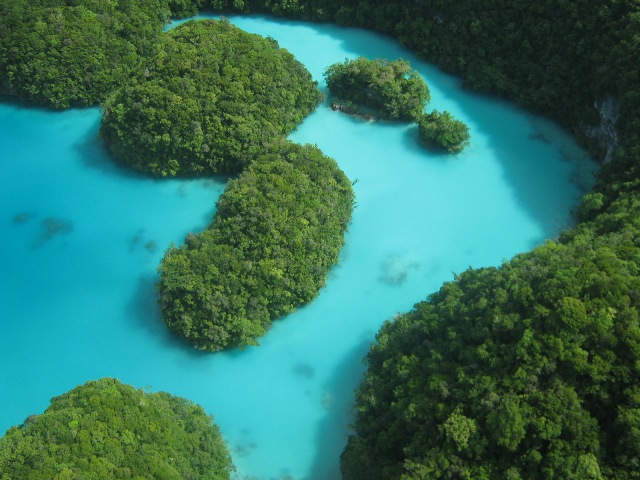
World famous 70 Islands and home of the Ngerukewid Islands Wildlife Preserve. A shallow lagoon surrounds the Preserve and a western barrier reef protects it from the open ocean's waves. At least 100 species of plants, 28 species of birds, 80 species of coral, 169 species of fish and 260 other marine invertebrates inhabit this Preserve. The relatively small size and the inaccessibility of the Ngerukewid Islands discourage inhabitants. No one is allowed into the Preserve without permission. The Rock Islands are linked in places by long, steep, heavily vegetated strips on upthrusted limestone. Islands are slowly undercut by wave action as well as chemical and biological erosion until, ultimately, they tumble into the lagoon to become a platform for additional coral growth. There are approximately 70 marine lakes in the Rock Islands. The lakes are very different from each other in terms of the marine life found in them. The marine lake vary in size. Smaller Lakes are the size of a small farm pond. Larger lakes can be as long as 1.25 miles.


Monday, April 26, 2010

The Stone Money of Yap


Yapese myths claim that an ancient navigator sailed his canoe 250 miles to the neigboring island of Palau and discovered a sparkling rock, which today's geologists call "crystalline calcite." This material forms the colorful, glistering walls of limestone caves that honeycomb Palau's Rock Islands.


According to the legends, the navigator instructed his sailing crew to carve pieces of rock in the shape of a full moon. A hole was cut in the center of the stone disks so that they could be carried on wooden poles. Radioactive carbon dating indicates the Yapese may have been producing stone money as fas back as 1,500 to 2,000 years ago.

Thursday, April 15, 2010

ROC Navy Arrives in Palau


April 13, 2010 the ROC Naval Ship arrive at Palau around 2:30 in the afternoon. Around 800 ROC Navy including its officers visit Palau for a 3-day exploration. They visit hotels, dine at restaurants, buy souviners and play in water for their 3-day stay here in Palau.